LiZZ-Lecture
Table of contents

Artificial Intelligence and Natural Language
Invited Speaker:
Mark Steedman, Professor of Cognitive Science, University of Edinburgh
Discussants:
Dr. Remo Nitschke, Institute for the Interdisciplinary Study of Language Evolution, UZH
Prof. em. Dr. Hans-Johann Glock, Department of Philosophy, UZH
Abstract:
Large Language Models have shown remarkable abilities in natural language processing, tempting many to speak of them as if they used and understood language as humans do. However, doing so overlooks the distinction between the structural systems that support meaning and reasoning and the mechanisms for predicting what will come next in a data that LLMs encode. LLMs excel at prediction, and it it is surprising how much can be done by memorization indexed by similarity alone. LLMs can answer abstruse questions, generate text of astonishing fluency on any subject in any style, and generate workable computer code and formal proofs in this way. They will continue to make progress in this way for some time to come.
However, some limitations of LLMs are becoming increasingly clear. They struggle with sound logical inference, they may include convincing yet wholly inaccurate information, and they have difficulty in generalizing code beyond superficial similarity to examples they have encountered during training. This lecture will present recent research that highlights both the capabilities of, and the constraints upon, these systems. Its conclusion will be twofold: that LLMs work in a very different way to humans, and have very little to tell us about the way human beings use language; and that the future of natural language processing lies in hybrid systems that combine the precision and structure of symbolic reasoning with the power of recall and access by similarity of content of neural computation.
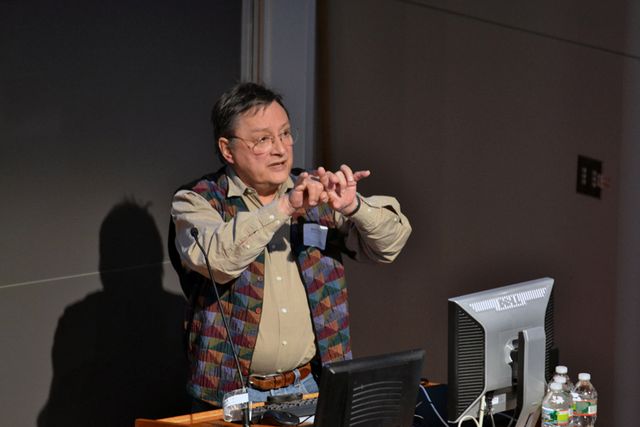
About the Speaker
Mark Steedman is Professor of Cognitive Science at the University of Edinburgh (School of Informatics). His research lies at the intersection of computational linguistics, artificial intelligence, and cognitive science. Among other topics, he works on generating meaning-bearing intonation for artificial speech systems, the communicative use of gesture, tense and aspect, as well as wide-coverage parsing and robust semantics within the framework of Combinatory Categorial Grammar (CCG). In addition, he works on computational music analysis and combinatory logic.
About the LiZZ-Lecture
The LiZZ-Lecture provides a unique stage for internationally recognized experts to present their cutting-edge research in language science. Rather than a standalone talk, each event is designed as an integrated dialogue: following the keynote, selected UZH scholars provide specialized commentaries that contextualize the speaker’s core themes through the lens of their own research domains.
This multi-layered approach highlights the inherent interconnectedness of our field, bridging different linguistic disciplines to offer a comprehensive look at the topic at hand. We then open the floor to the audience, inviting you to engage directly with the speakers and contribute to the discussion.
If you are looking to gain in-depth insights and witness how scientific ideas are explored from diverse viewpoints, we invite you to join us at the next LiZZ-Lecture.
The event is open to the public. Everyone is welcome to attend!
Registration
For the organization of the apéro, we kindly ask you to register in advance.
|
Details: |
Date: 21. April 2026 |